

Unlock the Fretboard: Master 12 Triad Voicings That Pro Guitarists Use Daily
Move beyond memorized shapes. Build a reliable mental map of harmony, create flexible chord voicings, and develop truly melodic solos—no matter the genre.
Triads are a simple tool, but an extremely powerful one. In this lesson, I’m going to teach you 12 different voicings that I use a lot myself. I also have a 2nd lesson on how to use these for comping. I call that one Comping With Triads.
Why triads? Because they are easy to play (only 3 notes) and they are the most powerful chord tones, which makes them useful for both rhythm and lead guitar. They provide you with freedom and they greatly help you understand the fretboard. You see, triads will open up the fretboard in a whole new way, if you study them carefully.
You have to really know these voicings like the back of your hand before you can start using them freely. So, that’s what this is all about. KNOWING where these triads are, on the 4 thinnest strings.
If you memorize these 12 voicings, and know which are the notes for each, you’ll be well on your way to play more melodically, with more variation, using powerful chord tones, compared to if you mostly rely on scale patterns (which can often be a really poor idea).
5 Essential Reasons Triad Mastery Will Fundamentally Change Your Guitar Playing
- Decipher Any Chord (The Foundation). Every major or minor chord you play is essentially a triad. Knowing them intimately allows you to break down bigger, complex chords into smaller, manageable pieces, instantly giving you a mental map of the harmony in any key, anywhere on the neck.
- Voice Chords Smoothly and Efficiently. Triads usually fit into small, portable 3-string shapes. This flexibility allows you to play the same chord in multiple positions without relying on open or standard barre shapes, leading to smoother transitions, better voice leading, and less stretching.
- Unlock Powerful Melodic Soloing. Triads are closely tied to the underlying harmony. When you know where these shapes lie, you can actively outline the chords in your solos, making your lines sound intentional, musical, and connected—a huge leap forward in any style (Blues, Rock, Jazz, etc.).
- Instant Fretboard GPS. Learning triads string by string teaches you how notes relate to each other across the neck. You start seeing the fundamental patterns, which builds a mental map that makes improvisation, transposing songs, and even composing your own material much easier.
- The Universal Language of Harmony. Triads immediately reveal the functional relationship between chords in a key (I, IV, V, vi, etc.). They are used universally across Blues (outlining changes), Rock (melodic fills), Jazz (building complex voicings), and Funk (tight rhythmic shapes).
Minor Triads
What is course 2 about?
It’s all about applying what we learned in the first course. I will teach you how to use these triad voicings for playing common chord progressions. The progressions are in the style of:
- Thrill Is Gone
- Brown Eyed Girl
- The Weight
- No Woman, No Cry
- Hit The Road, Jack
- Pachelbel’s Canon
For each of the 6 studies above, we learn how to play the progression, up and down the neck, using the triad voicings you learned in the first course.
What is course 3 about?
In this course, we will focus on Dominant Chords, because those are the ones we used the most in blues-based music.
This course is structured logically. We start by looking at some basic theory – how triads are constructed, and how we build Dominant 7 chords. I also explain how minor 7 and major 7 chords are created. The course includes both Dominant 7 chords, as well as their extensions (9, 11, 13 chords) and I explain it all in enough detail for you to both understand and utilize these concepts.
After that, I will share with you the Dominant chord voicings I use the most in my playing. We will also practice these voicings, one by one, to a drum track. Last time I counted all the chord diagrams I used for this course, I realized there are 113 chords voicings in this course… in other words, plenty to keep you busy! Remember, you only have to learn the ones you really like. By learning the concept of how they are created, however, you’ll be able to create your own voicings. It’s really quite simple.
The 3rd ingredient in this course is taking some of these chord voicings and use them in a blues tune. So, I have created 6 specific lessons for this, and each has its own backing track. For 3 of these examples, I will use the simpler 3-note chord voicings, and we stick to only those throughout the tune. For the other 3 examples, I make it a bit more challenging by using 4-note voicings, and I’ll use 2 sets of those for playing through the tune. That way, you can progress from playing simpler voicings to more challenging ones, so this is a good way for you to improve your chord voicing abilities.
How this will help you
Learning (some of) these chord voicings as shown will make it possible for you to jam along with pretty much any blues tune, and you’ll have lots of options for great sounding “blues chords”. But it’s not just about the chords either! I start out with teaching you simpler strumming approaches at first, but some of these examples have faster, funky and groovy strumming techniques, which is a key ingredient to sounding like a good player! There are examples you may find very challenging, but I think that is a good thing in the end. Furthermore, you can (and should) develop your own strumming patterns over songs like this. I do think, however, that my examples will come in very handy for a lot of players. The tracks are also fun blues tunes to use for soloing!
Order Here
Save $94 on the bundle:
Individual Courses
Truefire Special Offer
Tip for you – Truefire is a lesson site packed with the most awesome content you can imagine. In fact, hundreds of top guitar teachers are available there.
You can get a fantastic discount on All Access by using this link – do take a look and explore all the great material there.
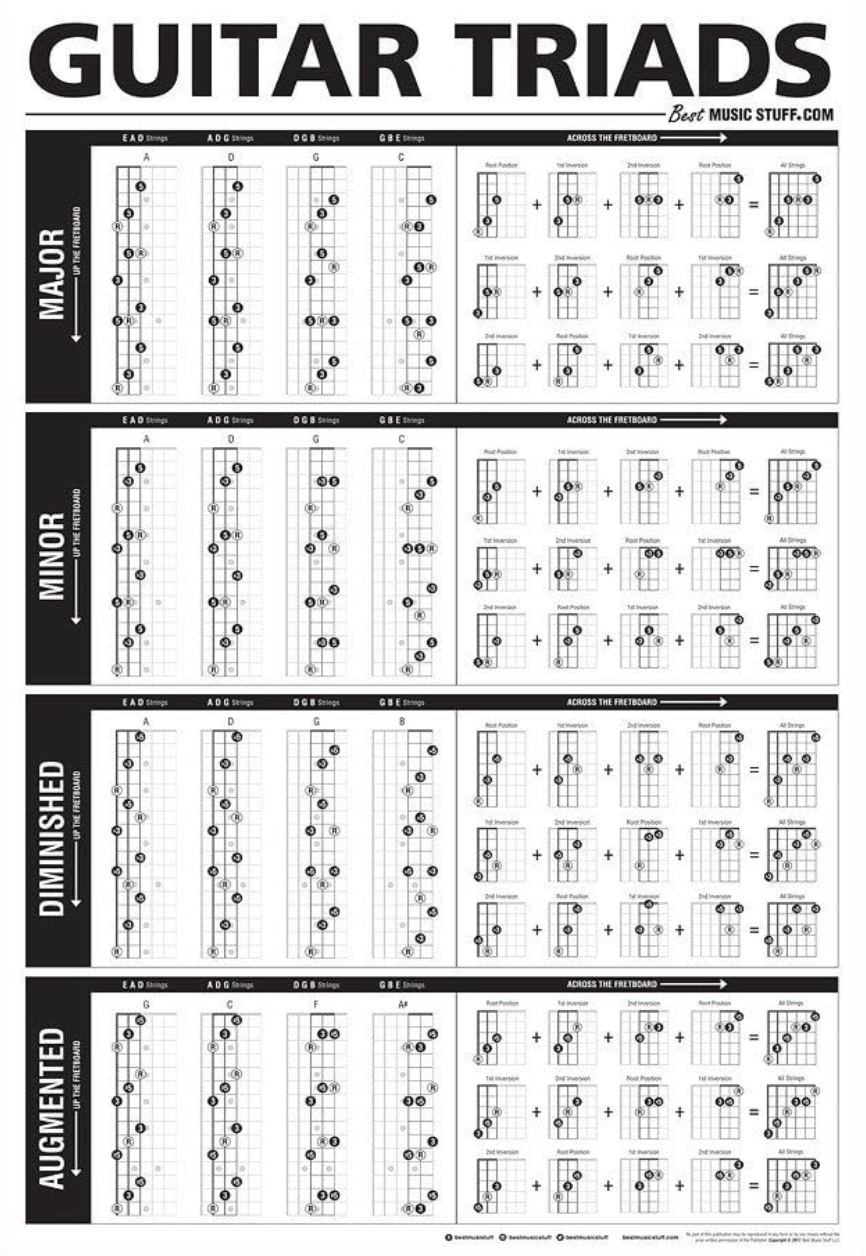
Triads Poster
This poster can be of great help – put it on the wall where you practice – very handy!
Testimonials
Submit your review | |
Absolutely smashing lesson and straight to the point. It's the secret to unlocking the fretboard or a good part of it. Thank you very much Robert. Bravo for the lesson.
Ahmed
I wish Robert developed more lessons like this. I learned more from these lessons than just about any I've purchased. And the best part is that once you know how to play the triads you can begin to make your own melodies and progressions that sound great.
I would like to say I liked your Triad Voicing course, I put your triad theory together awhile back, but I got a lot more out of getting your course and thankyou for putting it out. It's a great theory tool for playing up the neck and getting around some tricky Bar chords, which suits me just great!
Robert's older courses all have great content, but the more recent ones have also hit the nail on the head in the format. Concepts broken down into bite-sized videos (instead of 1 hour plus lessons), matched with backing tracks and excellent (easy to read) TABs. This course is no exception, with each lesson building on the skills and knowledge you acquire in the previous ones.
I've been through this course from beginning to end. If you want to learn your major and minor triads on the first four strings using an approach that will certainly engrain in your fingers and memory for a long time, this is the course you need. Not to mention the chord progressions and soloing courses that will follow this one and take your fret board knowledge, comping and soling chops to the next level. A super bargain for a super quality course, presented by a first class instructor. Don't miss out!
Another awesome course from MGA! This course will help you to learn and understand the notes on the neck. If you want to learn the sweet notes, the key notes that sound so sweet over the underlying chords then get this course and dig into it. This is gold that will help get your playing sounding sweet! You can't go wrong with this course and especially at this price! It's a bargain.